

August 12, 2026 · RiseFrst
Mission-Based Alarm: Revolutionize Your iPhone Wake-Up
Discover how mission-based alarms transform your morning routine by requiring tasks to turn off. Stop hitting snooze and build lasting momentum with RiseFrst.
How Mission-Based Alarms Revolutionize Your Morning with RiseFrst
You already know the pattern. The alarm sounds. Your hand reaches out—almost automatically—and hits snooze. Five more minutes. Then five more. Before you realize it, you're rushing through your morning, stressed and behind schedule, wondering why you can't seem to break the cycle.
The truth is, traditional alarms weren't designed to help you actually get up. They were designed to make noise. And when the only thing standing between you and more sleep is a simple tap, willpower alone rarely wins.
Mission-based alarms change everything. Instead of passively silencing your alarm, you're required to complete a specific task—a mission—before it turns off. This small shift creates immediate engagement, disrupts your autopilot snooze habit, and gives you that crucial first win of the day. For iPhone users struggling with oversleeping and inconsistent mornings, this approach offers a practical, structured solution that builds real momentum.
In this article, we'll explore exactly what makes mission-based alarms different, why they work from a behavioral science perspective, and how RiseFrst's unique approach to photo-based missions and routine building can transform your mornings from chaotic to consistent.
Beyond the Beep: What Exactly is a Mission-Based Alarm?
A mission-based alarm flips the traditional wake-up experience on its head. While standard alarms simply ring until you tap a button, mission-based alarms require you to complete a specific task before they'll stop. This isn't about making wake-up annoying—it's about making it active.
The mission itself varies depending on the app and your preferences. Common examples include solving math problems, scanning a QR code placed across the room, shaking your phone vigorously, or—as RiseFrst specializes in—taking a photo of a specific object or location.
The key difference lies in engagement. When your alarm requires you to physically move, think, or interact with your environment, you're no longer operating on autopilot. Your brain must wake up enough to complete the task, and by the time you've finished, you've already overcome the hardest part: getting out of bed.
Photo-based missions offer a particularly effective approach. By requiring you to walk to your bathroom, kitchen, or another designated spot and photograph a specific item, you're not just engaging your mind—you're physically removing yourself from the temptation of your bed. The combination of movement, light exposure, and purposeful action creates a natural momentum that carries into the rest of your morning.
How Mission-Based Alarms Differ from Traditional Alarms
Traditional alarms are passive triggers. They alert you to the time, but they don't help you act on that information. Mission-based alarms are commitment devices—tools that make your desired behavior (getting up) easier than the undesired behavior (staying in bed).
This distinction matters because habit formation isn't just about intention. It's about reducing friction for good behaviors and increasing friction for bad ones. When hitting snooze becomes harder than getting up, your default behavior changes.
The Science of Waking Up: How Missions Combat Snooze Culture
Understanding why mission-based alarms work requires looking at the psychology of habit formation and decision-making. When you're half-asleep, your prefrontal cortex—the part of your brain responsible for rational decision-making—isn't fully online yet. You're operating primarily on habit and immediate impulse.
In this state, the path of least resistance almost always wins. If the easiest action is tapping snooze, that's what you'll do, regardless of how committed you were the night before to waking up early.
Mission-based alarms leverage several psychological principles to shift this dynamic:
Immediate Action Overcomes Inertia
Physics teaches us that objects at rest tend to stay at rest. The same applies to people in bed. The longer you remain horizontal and sleepy, the harder it becomes to get up. By requiring immediate action—standing, walking, focusing—mission-based alarms interrupt this inertia before it strengthens.
Research on habit formation, as explored in The Power of Habit, shows that the first action in a sequence often determines the entire chain that follows. When your first action is getting out of bed and completing a mission, you've already started your day productively.
Environmental Design Supports Desired Behavior
James Clear's Atomic Habits emphasizes the importance of environmental design in behavior change. Mission-based alarms are a form of environmental design—they restructure your wake-up environment to make the desired behavior more likely.
By placing your mission target (whether it's a QR code or a specific object to photograph) in another room, you're using your space to support your goals. You're not relying on willpower alone; you're making your environment work for you.
The Commitment Device Effect
Behavioral economists discuss commitment devices as tools that lock you into a future action. Mission-based alarms function as a morning commitment device. By setting up the alarm the night before, you're making a decision for your future self—one that's much harder to undo when you're groggy and tempted to sleep in.
This concept is explored in Nudge, which discusses how choice architecture influences behavior. Your alarm's mission becomes a nudge that guides you toward your intended action without requiring extraordinary willpower.
Breaking the Snooze Loop
The snooze button creates a problematic cycle. Each time you hit it, you're reinforcing the habit of delaying. You're also fragmenting your sleep into low-quality chunks that leave you feeling groggier than if you'd simply gotten up at the first alarm.
Mission-based alarms break this loop by making snooze either impossible or significantly more effortful than getting up. This disruption is often all it takes to establish a new, healthier pattern.
RiseFrst's Edge: Tailoring Your Wake-Up Mission for Success
While the concept of mission-based alarms isn't entirely new, RiseFrst brings a focused, user-centered approach that addresses the specific needs of iPhone users seeking consistent morning success.
Photo-Based Tasks That Feel Natural
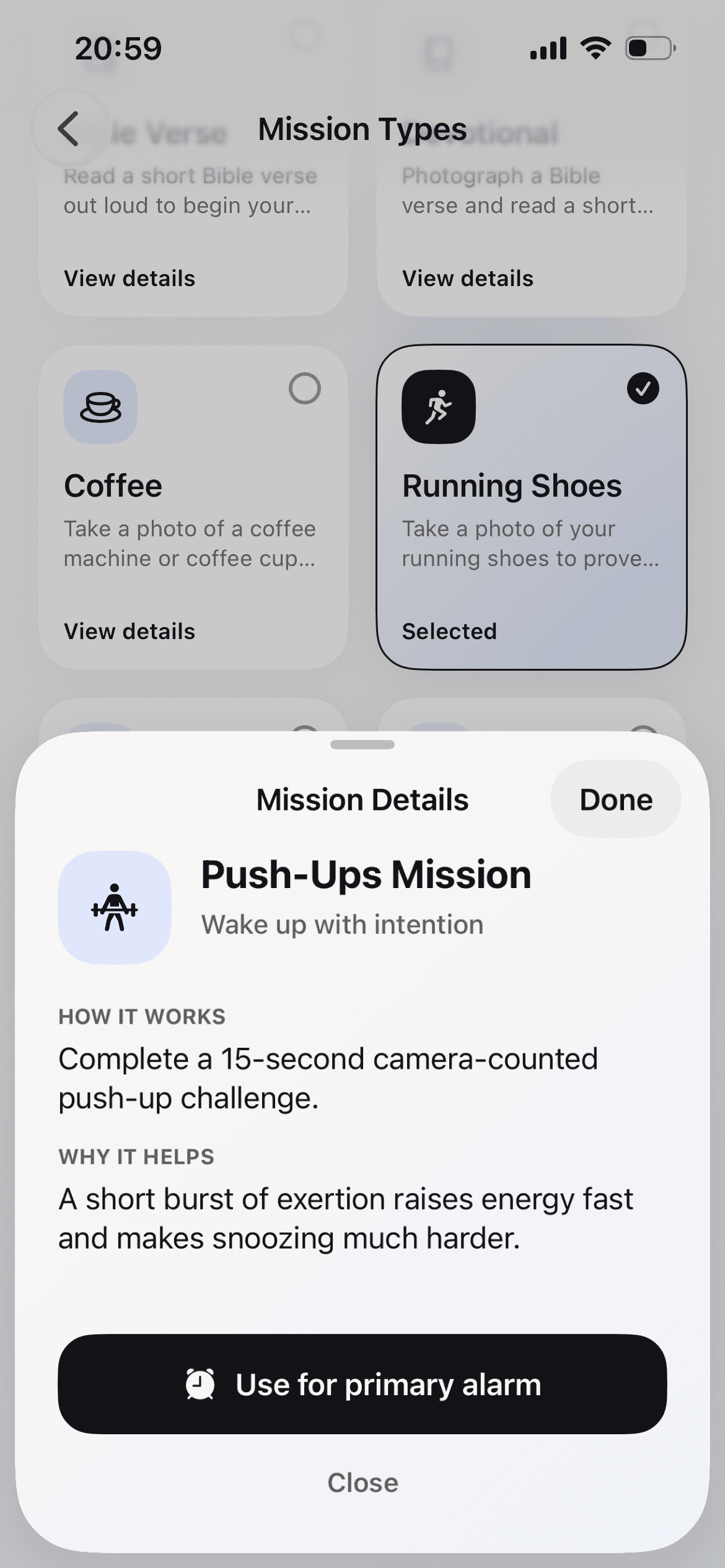
RiseFrst's core mission mechanism centers on photo-based tasks. Instead of arbitrary math problems or generic puzzles, you photograph something meaningful in your space—your coffee maker, your window view, your workout gear.
This approach offers several advantages. First, it's intuitive and quick. You're not fumbling with complex puzzles when you're half-awake. Second, it creates a visual connection between your alarm and your morning routine. Photographing your coffee maker becomes a natural cue to actually make coffee. Photographing your yoga mat becomes a prompt to exercise.
The RiseFrst iPhone alarm app allows you to customize your photo targets, making each mission personal and relevant to your specific morning goals.
Flexible Alarm Setups for Real Life
Consistency doesn't mean rigidity. RiseFrst recognizes that your weekday morning might look different from your weekend routine. The app offers flexible alarm setups that let you create different missions for weekdays, weekends, or focused mornings when you need extra structure.
This flexibility prevents the all-or-nothing thinking that derails many habit-building attempts. You don't have to be perfect every single day—you just need a system that adapts to your life while maintaining forward momentum.
Seamless Integration with iPhone Features
As a native iPhone application, RiseFrst leverages the device's camera, notifications, and user interface in ways that feel natural to iOS users. There's no learning curve for basic functionality—you're using tools you already understand in a smarter, more purposeful way.
Building Momentum: Integrating Missions into Your Morning Routine
Completing your wake-up mission is just the first domino. The real power comes from using that initial success to launch a complete morning routine that sets you up for a productive day.
Chaining Actions for Compound Success
Habit stacking—performing one behavior immediately after another—is one of the most effective strategies for building routines. Your mission-based alarm naturally creates the first link in this chain.
For example, if your mission requires photographing your kitchen sink, you're already in the kitchen. From there, it's a short step to drinking a glass of water, starting coffee, or reviewing your daily goals. Each small action builds on the previous one, creating a cascade of positive behaviors.
RiseFrst's morning routine builder helps you plan these sequences intentionally. Rather than wandering aimlessly after your alarm, you have a clear roadmap for your first 30-60 minutes.
Creating Meaningful First Wins
The psychological impact of early success shouldn't be underestimated. When you complete your wake-up mission, you've already accomplished something before most people have even opened their eyes. This creates a sense of competence and momentum that colors the rest of your day.
By designing missions that connect to larger goals—photographing workout equipment if you want to exercise, or your journal if you want to write—you're reinforcing your identity as someone who follows through on intentions.
Adapting Your Routine as You Grow
What works in week one might need adjustment by week four. The beauty of the RiseFrst approach is its flexibility. As you build consistency with one routine, you can gradually add complexity, shift your wake-up time, or refine your missions to match your evolving goals.
This progressive approach prevents overwhelm while ensuring you're always challenging yourself just enough to maintain growth without triggering burnout.
From Struggle to Streak: Tracking Your Progress with RiseFrst
Consistency is the foundation of lasting change, but consistency can be hard to see without the right feedback mechanisms. This is where progress and streak tracking become invaluable.
Visualizing Your Success Pattern
RiseFrst's progress tracking transforms abstract concepts like "getting better at mornings" into concrete, visible data. When you can see that you've successfully completed your wake-up mission 23 days out of the last 30, or that your current streak is 12 days, you're no longer guessing about your progress—you're seeing it.
This visibility serves multiple purposes. It provides motivation on difficult mornings ("I don't want to break my streak"), validation when you're questioning whether your efforts matter ("Look how far I've come"), and insight when you need to adjust ("I always struggle on Mondays—maybe I need a different approach").
The Power of Streaks
Streak tracking taps into a powerful psychological motivator: loss aversion. Once you've built a streak of several days or weeks, the prospect of breaking it creates additional motivation to get up and complete your mission.
This isn't about perfection or creating unhealthy pressure. It's about making your progress visible and giving yourself credit for showing up consistently. Even if you break a streak, the data shows you how quickly you can rebuild it, turning setbacks into learning opportunities rather than failures.
Identifying Patterns and Optimizing
Over time, your tracking data reveals patterns you might not notice day-to-day. Maybe you consistently struggle after late nights, or your success rate is higher when you go to bed before 11 PM. These insights allow you to make informed adjustments to your overall routine, not just your morning alarm.
The combination of mission-based alarms and robust tracking creates a complete system for morning transformation—one that doesn't rely on temporary motivation but builds genuine, sustainable habits.
Making the Shift: Your First Steps with Mission-Based Alarms
Changing how you wake up is one of the most impactful shifts you can make, because it affects literally every day that follows. If you're ready to move beyond the snooze button and build genuine morning momentum, here's how to start:
Choose Your First Mission Wisely
Don't try to be heroic on day one. Choose a mission target that's close enough to make success likely (you don't want to navigate stairs half-asleep if you're not ready), but far enough to require actually getting out of bed. Your bathroom mirror, kitchen counter, or a window are all excellent starting points.
The key is picking something you'll encounter naturally as part of your desired morning routine. This creates a seamless transition from "alarm completed" to "routine started."
Start with Your Most Important Day
Rather than trying to change all seven days at once, begin with your most critical morning—usually a weekday when you have important commitments. Build consistency there first, then expand to other days as the habit solidifies.
This focused approach prevents the overwhelm that comes from trying to change everything simultaneously.
Prepare Your Environment the Night Before
Set yourself up for success by preparing your mission target area before bed. If you're photographing your coffee maker, make sure it's clear and visible. If it's your workout gear, lay it out where you'll see it immediately.
This preparation reduces friction and increases the likelihood of follow-through when you're still groggy.
Expect Imperfection, Track Progress Anyway
You won't execute perfectly every single day, and that's okay. What matters is the overall trend. Are you waking up consistently more often than you were a month ago? Are you hitting snooze less frequently? These are the metrics that matter.
Use RiseFrst's tracking features to celebrate progress, not to judge yourself for occasional struggles.
Conclusion
The mission-based alarm isn't just a clever trick to make your alarm harder to dismiss—it's a fundamental reimagining of what a wake-up tool should do. Rather than simply alerting you to the time, it actively helps you change your behavior, build momentum, and start each day with intention.
For iPhone users who've struggled with oversleeping, endless snoozing, or inconsistent morning routines, this approach offers something traditional alarms never could: a structured path from intention to action. By requiring immediate engagement, leveraging environmental design, and creating that crucial first win of the day, mission-based alarms transform your most vulnerable moment—those first few seconds of waking—from a battle of willpower into a system that works with your psychology, not against it.
RiseFrst takes this concept further by focusing on photo-based tasks that integrate naturally with morning routines, offering flexible setups that respect real-life complexity, and providing the progress tracking that turns occasional success into lasting habits. The result isn't just earlier wake-ups—it's genuine momentum that carries through your entire day.
Your morning sets the tone for everything that follows. When you start with clarity, purpose, and a small win already in your pocket, you're not just awake—you're ready. And that difference, compounded over weeks and months, changes everything.
Frequently Asked Questions
What makes a mission-based alarm different from a regular alarm?
A mission-based alarm requires you to complete a specific task—like taking a photo, solving a puzzle, or scanning a code—before it will turn off. Unlike regular alarms that stop with a simple tap, mission-based alarms force immediate engagement, disrupting the autopilot snooze habit and helping you actually get out of bed.
Why are photo-based missions more effective than other alarm types?
Photo-based missions combine physical movement with purposeful action. By requiring you to walk to a specific location and photograph an object, you're physically removing yourself from bed, exposing yourself to light, and creating a natural transition into your morning routine. This feels more natural than arbitrary puzzles and directly connects to your actual morning activities.
Can I use different missions for weekdays versus weekends?
Yes, RiseFrst offers flexible alarm setups that let you create different missions and schedules for weekdays, weekends, or any custom arrangement. This flexibility helps maintain consistency without forcing rigid, one-size-fits-all routines that don't match real life.
How does streak tracking help with building a consistent wake-up habit?
Streak tracking makes your progress visible and leverages loss aversion—once you've built a streak of several days, you're motivated to maintain it. It also provides concrete evidence of your success, helps identify patterns in your behavior, and transforms abstract goals into measurable achievements you can celebrate.
What should I choose as my first photo mission target?
Choose something you naturally encounter during your ideal morning routine—your bathroom mirror, coffee maker, kitchen window, or workout gear. It should be far enough from bed to require getting up, but not so far that it feels overwhelming when you're starting out. The best targets create a seamless transition from completing your mission to beginning your routine.
Ready to stop hitting snooze and start building real morning momentum? Download RiseFrst today and experience how mission-based alarms transform your wake-up from a daily struggle into a consistent success. Your best mornings are waiting.